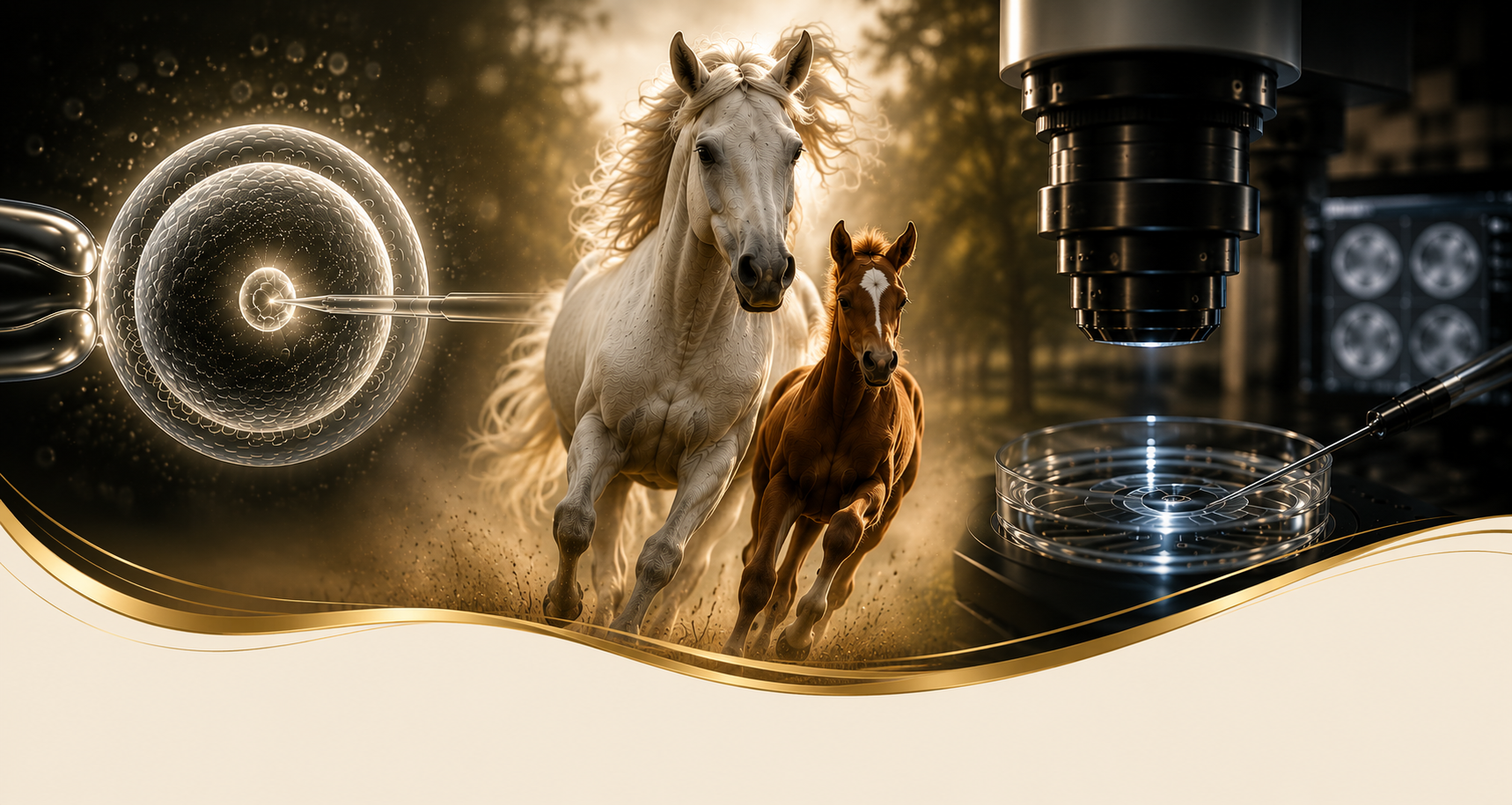
What is OPU and ICSI?
A Guide for Horse Owners
Modern reproductive technologies have made it possible for many mares that are unable to conceive naturally to produce healthy foals. This is where advanced technology such as Intracytoplasmic Sperm Injection (ICSI) can be a valuable tool. Ovum Pick-Up (OPU) is the first step in the ICSI process.
These procedures are commonly used in valuable performance mares, older mares, mares with reproductive problems, or mares that are still actively competing.
What is OPU?
OPU (Ovum Pick-Up) is a minimally invasive procedure used to collect immature eggs (oocytes) directly from a mare's ovaries.
The procedure is performed under sedation using an ultrasound-guided needle that gently aspirates the follicles on each ovary.
Unlike embryo transfer, the mare does not need to be in season or ovulating for eggs to be collected.
The collected eggs are immediately transported to the laboratory where they are prepared for fertilisation.
What is ICSI?
ICSI (Intracytoplasmic Sperm Injection) is a specialised laboratory technique where a single carefully selected sperm is injected directly into each mature egg using a high-powered microscope and precision micromanipulation equipment.
This differs from conventional IVF, where many sperm are placed around the egg and fertilisation occurs naturally. Horses do not fertilise reliably using standard IVF techniques, making ICSI the preferred method.
After fertilisation, the developing embryo is cultured in the laboratory for approximately 7–9 days before being transferred into a recipient mare or frozen for future use.
Why choose OPU and ICSI?
OPU and ICSI can provide opportunities for mares that may not be suitable candidates for traditional embryo transfer.
Common reasons include:
Older mares with reduced fertility
Mares that fail to produce embryos through conventional embryo transfer
Competition mares with tight competition schedules that cannot take extended periods off work.
Mares with uterine disease but healthy ovaries
Limited or valuable frozen semen
Stallions producing low sperm numbers or poor-quality semen
Preserving valuable genetics from elite mares
The OPU Process
1. Mare assessment
Reproductive examination
Ultrasound of the ovaries - it is recommended that mares have at least 12-15 follicles between 10-25mm in size prior to performing OPU.
General health assessment
2. OPU procedure
Mare is sedated
Eggs are collected using ultrasound guidance
Mares return home the following morning
3. Laboratory
Eggs are identified and matured
Mature eggs undergo ICSI
Embryos are cultured for approximately one week
4. Embryo transfer or freezing
Suitable embryos are transferred into a recipient mare
Alternatively, embryos can be frozen for future transfer
Is the procedure safe?
OPU is considered a safe procedure when performed by experienced veterinarians.
Most mares:
Return home the following morning
Resume normal activities within 3 days
Experience only mild discomfort following the procedure
As with any veterinary procedure, there are small risks associated with sedation and ovarian aspiration, which your veterinarian will discuss with you.
How many eggs will my mare produce?
Every mare is different.
The number of eggs collected depends on factors including:
Age
Breed
Individual ovarian function
Time of year
Previous reproductive history
Some mares may produce only a few eggs per session, while others produce considerably more.
It is important to remember that every egg does not become an embryo, and every embryo does not become a foal.
Can frozen semen be used?
Yes.
One of the greatest advantages of ICSI is that only a single sperm is required for each mature egg.
This allows valuable frozen semen to be used very efficiently and enables pregnancies from semen samples that may be unsuitable for conventional artificial insemination.
Frequently Asked Questions
Will my mare need to stay in hospital?
We recommend that mares stay for the night after the procedure to monitor comfort level after the procedure.
Does my mare need to be cycling?
No. OPU can often be performed regardless of where the mare is in her reproductive cycle.
How long does the laboratory process take?
Embryos are typically cultured for 7–9 days before transfer or freezing.
What are the success rates?
Success depends on many factors, including mare age, egg quality, semen quality, and laboratory techniques.
Industry standard success rates suggest that 60% of OPU procedures will produce 1 or more embryos.
Our Commitment
At Hawkesbury Equine Veterinary Centre, we combine advanced reproductive technology with personalised veterinary care to maximise every mare's reproductive potential.
From initial fertility assessment through to embryo production and recipient mare management, our experienced team is committed to delivering the highest standard of reproductive care.
If you would like to learn more about OPU or ICSI, please contact our team to discuss whether these techniques are suitable for your mare.
For more information or to book in your mare please fill in the below form