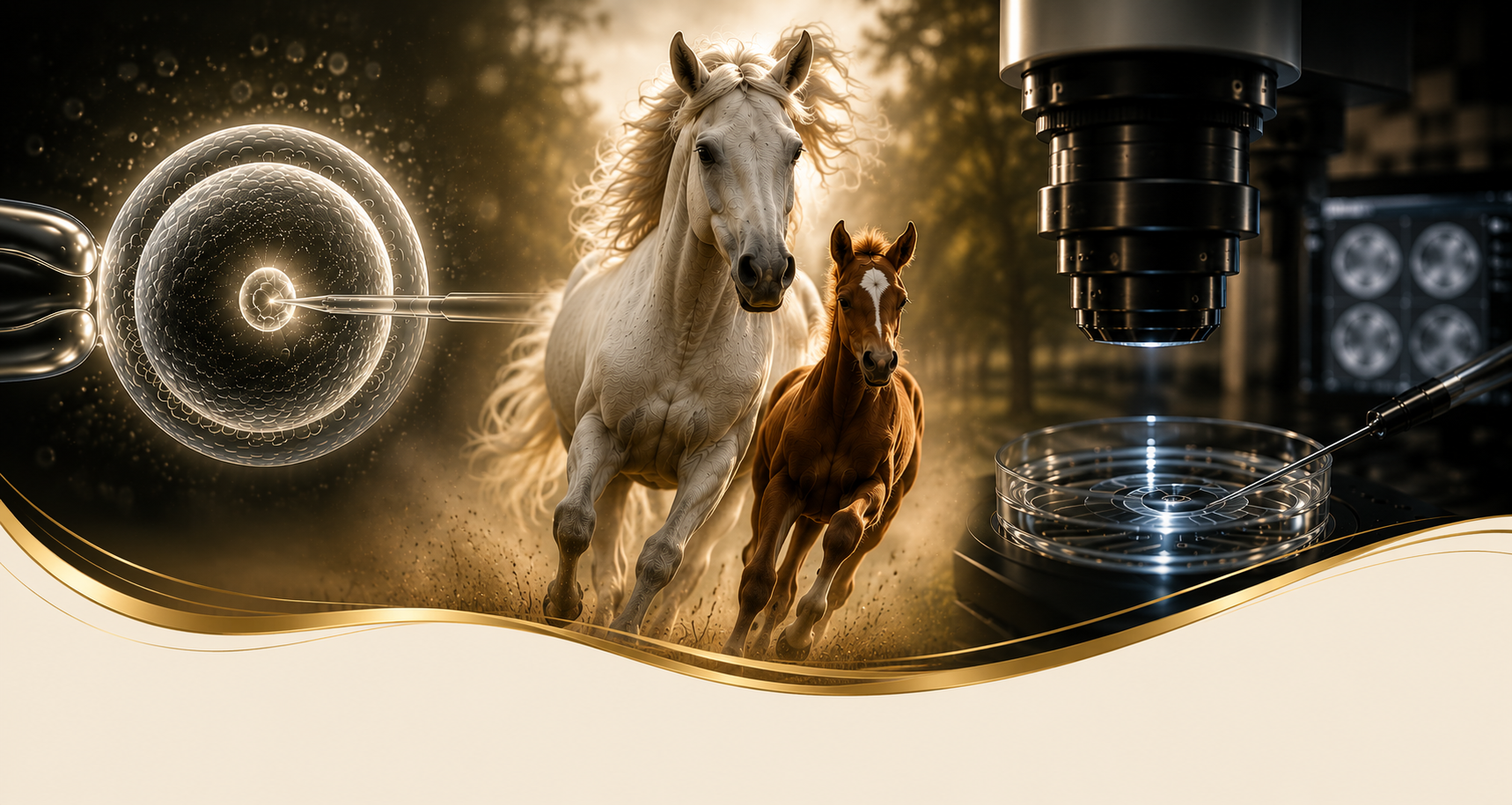
What is Embryo Transfer?
Helping your mare produce a foal while continuing her careerA Guide for Horse Owners
Embryo Transfer (ET) is one of the most widely used assisted reproductive techniques in the equine industry. It allows a mare to produce a foal without carrying the pregnancy herself.
After the embryo is collected from the donor mare, it is transferred into a carefully selected recipient mare, who carries the pregnancy to term and raises the foal.
Embryo transfer is commonly used in performance mares, valuable broodmares, and mares that are unable to safely carry a pregnancy.
How does Embryo Transfer work?
Embryo transfer involves breeding a donor mare while synchronising the reproductive cycle of a recipient mare.
The donor mare is inseminated with fresh, chilled, or frozen semen at the appropriate time. Approximately 7–8 days after ovulation, the uterus is gently flushed to recover the embryo.
If an embryo is successfully recovered, it is examined under a microscope before being transferred into a synchronised recipient mare.
The recipient mare then carries the pregnancy for the remainder of gestation and delivers the foal.
Why choose Embryo Transfer?
Embryo transfer offers many advantages for both mares and breeders.
Common reasons include:
Performance mares can continue competing while producing foals.
Older mares with healthy ovaries but unsuitable uterine conditions may still produce embryos.
Mares with previous foaling injuries or medical conditions can continue their breeding program.
Multiple embryos may be collected from a mare during a breeding season.
Valuable genetics can be preserved while reducing the physical demands of pregnancy on the donor mare.
Embryos can often be frozen for transfer at a later date.
The Embryo Transfer Process
1. Mare Assessment
Before breeding begins, your veterinarian will perform:
A full reproductive examination
Ultrasound assessment of the uterus and ovaries
General health evaluation
2. Breeding the Donor Mare
The donor mare is inseminated using:
Fresh semen
Chilled semen
Frozen semen
Ovulation is closely monitored to ensure breeding occurs at the optimal time.
3. Embryo Collection
Approximately 7–8 days after ovulation, the uterus is gently flushed with sterile fluid.
The flushing fluid is filtered, allowing the embryo to be located and assessed under a microscope.
The procedure is generally well tolerated and most mares return to normal activity immediately afterwards.
4. Embryo Transfer
A healthy embryo is transferred into a synchronised recipient mare using a non-surgical procedure.
The recipient mare is then monitored by ultrasound to confirm pregnancy.
What is a Recipient Mare?
A recipient mare is a healthy mare selected to carry the pregnancy on behalf of the donor mare.
Recipient mares are carefully chosen based on:
Excellent reproductive health
Good temperament
Appropriate age and body condition
Synchronisation with the donor mare's cycle
The genetics of the foal come entirely from the donor mare and stallion. The recipient mare does not contribute any genetic material.
Is Embryo Transfer safe?
Yes.
Embryo transfer is considered a safe and well-established reproductive technique.
Most donor mares:
Return home the same day
Continue normal exercise or competition programs
Show minimal discomfort following embryo collection
The embryo collection procedure is non-surgical and performed with the mare standing under light restraint.
What affects success rates?
Several factors influence the likelihood of recovering an embryo and achieving a pregnancy, including:
Mare age
Uterine health
Fertility of both mare and stallion
Semen quality
Timing of ovulation and insemination
Recipient mare quality and synchronisation
Your veterinarian will discuss the expected success rates for your individual mare.
Frequently Asked Questions
Can my mare continue competing?
Yes. One of the greatest advantages of embryo transfer is that many mares can remain in work while producing foals.
Does embryo collection hurt my mare?
The procedure is generally very well tolerated. Most mares show little or no discomfort and return to their normal routine immediately afterwards.
Can frozen semen be used?
Yes. Fresh, chilled, and frozen semen can all be used successfully, depending on the stallion and breeding plan.
What happens if no embryo is recovered?
Not every breeding cycle results in an embryo. If no embryo is recovered, your veterinarian will discuss possible reasons and develop a plan for the next cycle.
Can embryos be frozen?
Yes. Suitable embryos can often be cryopreserved and transferred into a recipient mare at a later date.
Our Commitment
At Hawkesbury Equine Veterinary Centre, we provide comprehensive embryo transfer services, from breeding management and donor mare care through to recipient mare management and pregnancy monitoring.
Our experienced veterinary team uses advanced reproductive techniques and personalised breeding plans to maximise your mare's reproductive success while ensuring the highest standard of care.
If you would like to learn more about Embryo Transfer or discuss whether it is the right option for your mare, please contact our team. We are here to guide you through every step of the breeding journey.
For more information or to book in your mare please fill in the below form